The Door Says 'Occupied.' The Confrontation Says Otherwise: A Field Guide to Restroom Politics With an Invisible Disability
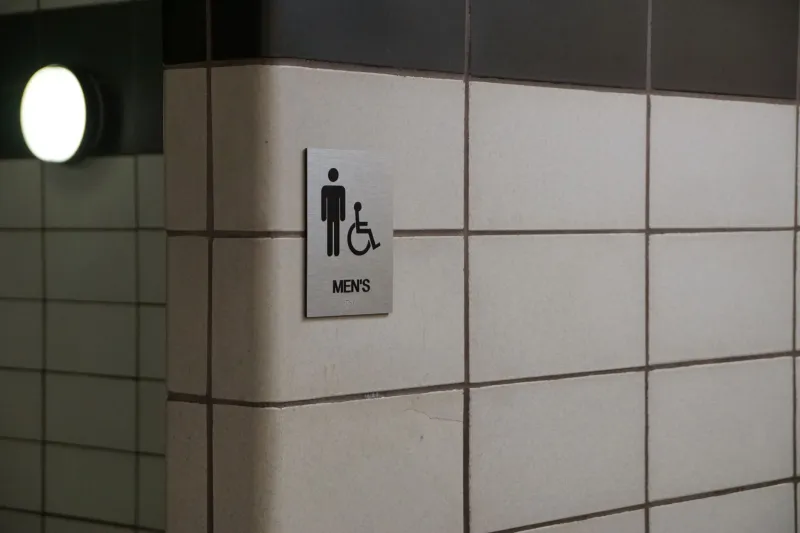
There's a particular kind of dread that comes with a door handle. If you live with Crohn's disease, a neurogenic bladder, an ostomy, POTS, or any of the dozens of conditions that make bathrooms a matter of urgency rather than convenience, you know the math you run every time you enter a restaurant, a stadium, a Target. Where is the restroom? How far is it? Is the accessible one occupied?
And then there's the part nobody warns you about: the audience. Because when you slip into the accessible stall and emerge a few minutes later, someone with a fully able body and a fully loaded opinion may be waiting to deliver it.
The Look You Know Too Well
We've heard from hundreds of readers about this moment. A woman in Ohio was told she should be "ashamed" for using the accessible stall when she "clearly didn't need it." A man in Arizona with ulcerative colitis was blocked by a stranger who insisted his grandmother "really needed that stall." A college student in Illinois, post-ostomy surgery at 22, started planning her entire class schedule around bathroom access — and around avoiding the people who policed it.
The pattern is consistent: because these disabilities don't show up on the outside, bystanders assume they don't exist at all. And restrooms, uniquely, are spaces where strangers feel entitled to audit your body in real time.
What the Law Actually Says (and Doesn't)
Here's the part that surprises people: restroom access for people with disabilities is a genuine patchwork in the United States, and most of it doesn't cover what you'd think.
The ADA requires that public accommodations provide accessible restrooms where restrooms exist — grab bars, turning space, sink height. But the ADA says nothing about who may use an accessible stall, or when. There is no federal rule reserving accessible stalls for people with disabilities, and there is no federal mechanism for proving you "qualify."
Some states have gone further. A handful, including Illinois, Texas, and parts of the UK-inspired legislation adopted elsewhere, offer programs for people with medical conditions affecting bladder or bowel control — the Illinois "Restroom Access Act," better known as Ally's Law, requires many retail establishments to let people with eligible medical conditions use employee-only restrooms. But enforcement is spotty, awareness is lower, and no state law will stop a stranger from glaring at you in a stall line.
That gap — between what the law guarantees and what everyday etiquette enforces — is exactly where people with hidden disabilities live.
You Don't Owe a Diagnosis at the Door
Let's be blunt: the idea that you must visibly justify yourself to use a bathroom is absurd on its face. Nobody asks a person with a cast to explain the fracture. But with an invisible condition, the burden of proof gets flipped onto you — and the correct answer is to decline the flip.
You do not need to disclose your condition, describe your symptoms, or produce a diagnosis. What you need is a script that ends the conversation without escalating it.
When someone comments on your use of the accessible stall:
- "I have a medical condition. I'm not going to discuss it, but I'm exactly where I'm supposed to be." Then walk away. You don't need to stay for their reply.
- Shorter version: "It's a medical need." Full stop. Brevity denies them a debate.
When someone asks why you 'look fine':
- "That's the thing about disabilities — most of them don't come with a visible checklist."
- Or simply: "I'll let you get back to your day." Delivered politely, it's a door closing, not a confrontation.
When a business questions you:
- Know your state's law before you need it. If you're in a state with a restroom access law, a calm "this is covered under [state] law, and I'd like to use the restroom now" usually resolves it. If not, the ADA's general accessibility requirements are your backstop for a conversation with a manager later — not a stall-side argument.
What We'd Change if We Wrote the Rules
Here's our opinion, stated plainly: the accessible stall shouldn't be a scarce resource people fight over in the first place. The real problem is that American businesses routinely under-build. A single accessible stall in a crowded venue means that stall becomes contested territory, and people with hidden disabilities become the targets of a scarcity problem they didn't create.
Advocates have long pushed for all-gender, single-occupancy restrooms in new construction — which serve wheelchair users, people with caregivers of any gender, and people with urgent medical needs simultaneously. Some cities, including Berkeley and Kansas City, have begun requiring them in certain new buildings. That's the direction we should be going: more doors, not more gatekeepers.
Until then, the etiquette shift has to come from all of us. If you see someone get confronted after leaving an accessible stall, say something. A simple "their needs are their business" does more than any pamphlet.
The Bottom Line
The next time you feel the weight of someone's stare as you exit that stall, remember: the ADA protects your right to access, but no law requires you to perform your disability for an audience. You're not taking anything from anyone. You're using a facility that exists because people like you fought for it.
And if all else fails? There's a reason our community keeps repeating it: your medical needs are real, they're valid, and they don't require a sign on your back — or anyone's permission slip in your hand.