Love in the Gap: When Your Partner Doesn't Quite Get Your Invisible Illness
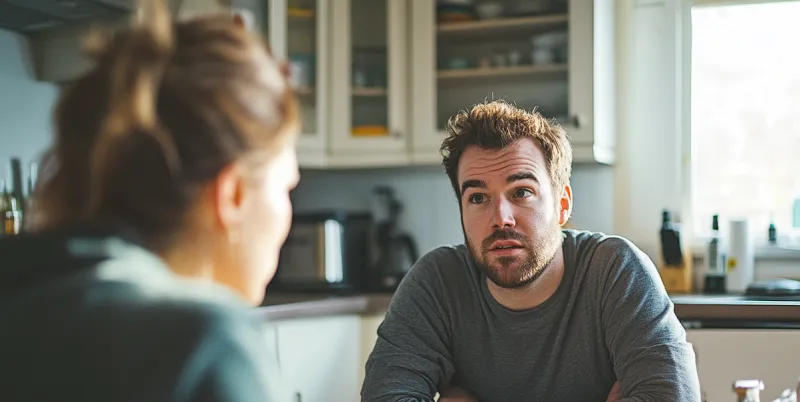
Photo: couple having serious conversation at home kitchen table, via cdn.thecelebritist.com
There's a particular kind of loneliness that comes not from being alone, but from being misunderstood by someone who loves you. For people living with hidden disabilities — chronic pain, autoimmune conditions, ADHD, anxiety disorders, PTSD, epilepsy, and dozens of others — that loneliness can settle right into the center of a relationship, quiet and persistent.
Your partner isn't cruel. They're not trying to make things harder. But when your disability doesn't show up on your face or slow your walk or require a mobility aid, it becomes incredibly easy for even the most well-meaning person to accidentally minimize what you're living with. And over time, that minimization can erode something real.
The Invisible Expectation Problem
Most relationship conflict around hidden disabilities doesn't start with a fight. It starts with an assumption.
Your partner assumed you'd be fine to go to that dinner party. You assumed they understood why you couldn't. Neither of you said anything directly, and now you're both sitting in the car on the way home, stiff with resentment.
This is what therapists sometimes call the "expectation gap" — the space between what one partner silently needs and what the other partner silently assumes. For people with visible disabilities, that gap can be narrower, because the disability itself communicates something. For people with hidden disabilities, the gap can stretch wide and stay wide for years.
Jamila, 34, who has lupus and lives in Atlanta, described it this way: "My husband would see me laughing at dinner with friends on a Saturday and then be genuinely confused when I spent all of Sunday in bed. He wasn't being mean. He just didn't have the context. And I kept forgetting that he couldn't see what I was carrying."
That forgetting — on both sides — is one of the most common dynamics hidden disability advocates and couples therapists talk about.
When to Disclose, and How Much to Say
There's no universal rule for when to tell a romantic partner about a hidden disability. Early disclosure can feel vulnerable and risky, especially if you've been dismissed before. Waiting too long can feel like concealment, even when that was never the intent.
What most relationship counselors suggest is thinking less about timing and more about readiness — both yours and theirs. Are you in a place where you can explain your experience without needing them to immediately fix it? Are they someone who has demonstrated they can sit with complexity without making it about themselves?
When you do share, specificity tends to land better than general statements. "I have fibromyalgia and it affects my energy in ways that aren't predictable" gives your partner something to work with. "I'm sick sometimes" doesn't.
It also helps to separate the disclosure from the request. Telling a partner about your condition is one conversation. Asking them to adjust their expectations or take on different responsibilities is another. Trying to do both at once can create confusion and defensiveness.
The Resentment Slow Burn
One of the most damaging things that can happen in a relationship affected by hidden disability is the slow accumulation of unspoken resentment — on both sides.
The partner with the disability may feel guilty for what they can't contribute, frustrated by having to constantly explain themselves, and quietly terrified that their partner will eventually decide the relationship is too much work. The partner without the disability may feel confused, occasionally overwhelmed by shifting responsibilities, and then ashamed for feeling overwhelmed at all.
Both experiences are valid. Both deserve space in the conversation.
Derek, 41, whose wife has ME/CFS (myalgic encephalomyelitis/chronic fatigue syndrome), shared that couples therapy was the turning point for them. "We weren't fighting about her illness directly. We were fighting about dishes and plans and money. It took a therapist to help us see that all of it was actually about the adjustment we hadn't fully made together."
Finding a therapist who has specific experience with chronic illness or disability is worth the extra effort. General relationship counseling can help, but a practitioner who understands the particular grief and logistical complexity of life with a hidden disability will be better equipped to guide both partners.
Building a Shared Language
One practical strategy that many couples find genuinely useful is developing a shared vocabulary for communicating about symptoms and capacity — without requiring a full medical briefing every time.
Some people use numeric scales ("I'm at a four today" meaning low energy, high pain). Others borrow frameworks like the spoon theory or the battery metaphor, even if they don't find those frameworks perfectly accurate for their own experience. The point isn't the metaphor — it's having a shorthand that removes the burden of constant explanation.
It also helps to schedule regular, low-stakes check-ins rather than waiting until something boils over. A weekly "how are we doing" conversation, separate from any acute conflict, can create a container for both partners to surface what's working and what isn't before it becomes a crisis.
When Love Isn't Enough on Its Own
Here's the part that's hard to say but important to name: love is necessary but not sufficient. A partner who loves you deeply can still hold beliefs about illness and limitation that cause harm. They may have absorbed cultural messages that equate visible suffering with "real" suffering. They may have their own unexamined fears about dependency or mortality that get projected onto you.
Loving someone with a hidden disability requires ongoing, active unlearning. It requires a willingness to be corrected when your assumptions are wrong, to sit with uncertainty, and to extend belief to experiences you cannot personally verify.
That's a lot to ask. But it's also exactly what love — at its most honest — actually looks like.
For those of us living with conditions the world can't easily see, finding a partner who's willing to do that work isn't a bonus. It's a baseline. And knowing that? That's its own kind of ability — one worth protecting.
If you're navigating relationship dynamics around a hidden disability, our community forums are open and active. You don't have to figure this out alone.