When First Responders Don't See the Whole Picture: Hidden Disabilities and the Crisis Response Gap
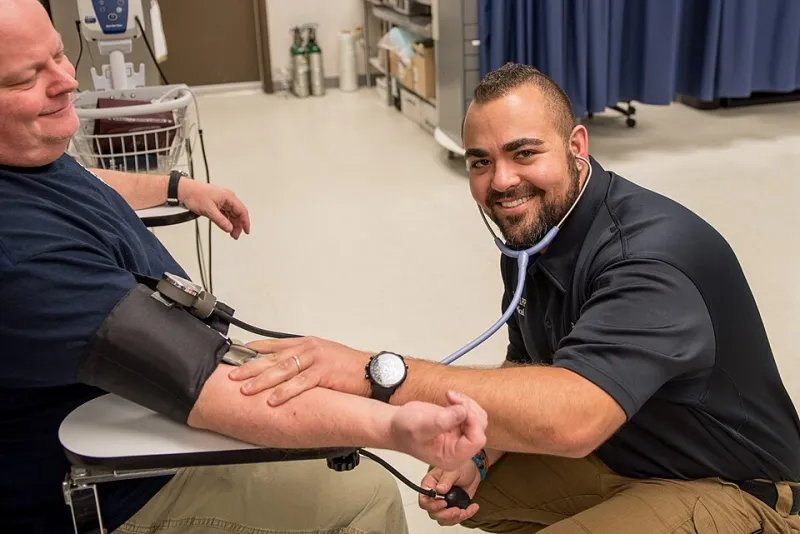
Photo: PEO ACWA, CC BY 2.0, via Wikimedia Commons
Imagine calling 911 because someone in your neighborhood seems to be in distress. They're pacing erratically, not responding to questions, and appear agitated. When officers arrive, the person doesn't make eye contact, doesn't follow verbal commands, and starts rocking back and forth. To a responder without specific training, this can look like intoxication, aggression, or mental illness requiring physical intervention. To a parent of an autistic child, it looks like a sensory meltdown.
The difference in interpretation can be the difference between a de-escalation and a tragedy.
Across the United States, emergency responders — police, EMS, fire departments — are frequently the first point of contact for people experiencing crises related to hidden disabilities. These are conditions with no visible markers: autism spectrum disorder, post-traumatic stress disorder, epilepsy, traumatic brain injury, chronic pain disorders, dissociative episodes, and a growing list of neurological conditions that affect behavior, communication, and physical response. And by nearly every measure, the training infrastructure to handle these encounters well remains deeply inadequate.
What the Documented Record Shows
The cases are not hard to find. In 2016, Charles Kinsey, a behavioral therapist in North Miami, was shot by police while lying on the ground with his hands raised, trying to calm an autistic client who had wandered into the street. The client, Arnaldo Rios Soto, was holding a toy truck. Officers later said they feared the object was a weapon. Rios Soto, who is nonverbal and autistic, was unharmed — but the incident became a flashpoint in national conversations about disability and policing.
In 2020, a Virginia teenager with autism was pepper-sprayed during a mental health call after officers interpreted his failure to comply with commands as defiance rather than disability-related communication differences. His mother had called for help.
These aren't isolated anomalies. Research published in the Autism journal found that autistic adults were significantly more likely to have had a negative encounter with law enforcement compared to neurotypical peers, often because behavioral responses — avoiding eye contact, stimming, slow processing of verbal instructions — were misread as hostility or impairment.
For people with PTSD, the dynamic is equally fraught. Unexpected physical contact, raised voices, or commands delivered in certain tones can trigger trauma responses that look, to an untrained eye, like combativeness. For someone experiencing a dissociative episode related to trauma, the inability to respond coherently to questions isn't evasiveness — it's a neurological event.
The Training Gap Nobody Wants to Own
So why does this keep happening? The short answer is that emergency responder training in the US is inconsistent, underfunded, and slow to incorporate disability-informed frameworks.
Police academy curricula vary dramatically by state. A 2022 analysis by the Police Executive Research Forum found that the average US police recruit receives roughly 21 weeks of academy training — with a heavy emphasis on firearms, defensive tactics, and legal procedure. Disability awareness, when covered at all, often amounts to a few hours of general mental health content that conflates psychiatric crisis with developmental disability and rarely addresses the specific behavioral presentations of conditions like autism, chronic pain, or TBI.
EMS training has similar blind spots. Paramedics are well-prepared for physiological emergencies but receive far less instruction on how to communicate with someone who is nonverbal, how to recognize a dissociative state versus a drug overdose, or how to modify their approach for a patient whose pain presentation differs from the norm — as it often does for people with fibromyalgia, Ehlers-Danlos syndrome, or other chronic invisible conditions.
"We get called to scenes where someone is in a mental health crisis and we're essentially winging it," said one paramedic in the Denver metro area who asked to remain anonymous. "The training I got on developmental disabilities was maybe two hours in a two-year program. That's not enough when you're trying to assess someone who can't tell you what's wrong."
What Disability Advocates Say Needs to Change
Organizations working at the intersection of disability rights and public safety have been pushing for systemic change for years. Their recommendations are specific, evidence-based, and largely affordable — what's missing is political will and departmental buy-in.
Mandatory, scenario-based disability training. Generic awareness modules don't build the kind of intuitive recognition that high-stress encounters demand. Advocates argue for simulation-based training that puts responders in realistic scenarios involving autistic individuals, people with PTSD, chronic pain patients, and others. Several departments, including those in Louisville and San Antonio, have partnered with disability organizations to develop this kind of curriculum — with measurable results in reduced use-of-force incidents.
Community registry programs. Some municipalities have implemented voluntary registries that allow residents with disabilities — or their caregivers — to flag their address and condition so that dispatchers can alert responding units before they arrive. These programs are not without privacy concerns, and participation must remain genuinely voluntary, but when implemented thoughtfully, they give responders critical context before a situation escalates.
Co-responder and alternative response models. Programs that pair law enforcement with mental health clinicians or disability specialists for certain call types have shown promise in cities like Eugene, Oregon, where the CAHOOTS model has operated for decades. Expanding these models to specifically include hidden disability specialists — not just mental health professionals — would address a current gap.
Plain-language and AAC awareness. Augmentative and alternative communication (AAC) devices are used by many nonverbal autistic individuals and others with communication differences. Training responders to recognize and wait for AAC communication, rather than interpreting silence or device use as non-compliance, is a low-cost, high-impact intervention.
Peer review and accountability. Departments should implement post-incident reviews specifically examining whether disability-related factors were considered during a call, with findings used to update training rather than simply filed away.
The Stakes Are Too High for Incremental Change
For families of people with hidden disabilities, every emergency call carries a specific kind of dread. Not just the fear of the crisis itself, but the fear of the response. That fear is not paranoia — it's learned from experience, from news stories, from community networks where these incidents are shared and mourned with devastating regularity.
At Hidden Abilities, we believe that emergency response systems should be built around the full spectrum of human neurological and physical reality — not just the narrow band of presentation that training programs have historically prepared responders for. The hidden in "hidden disability" should never mean hidden from the people whose job it is to help.
This is a solvable problem. The tools exist. The models exist. What's required now is the institutional commitment to take hidden disabilities as seriously in emergency protocols as any other factor affecting how a person presents in a crisis.
Because when that commitment is missing, the consequences aren't abstract. They're somebody's child, somebody's parent, somebody's neighbor — in a situation that should have been handled with care, and wasn't.